
6 min read · Last updated October 15, 2026
- A rule in the Code of Federal Regulations (CFR), 7 CFR 251.5, bars every state from requiring ID, proof of address, or proof of how long you’ve lived there to get food through The Emergency Food Assistance Program (TEFAP).
- States set their own income ceiling between 185% and 300% of the federal poverty level. Minnesota uses the full 300%, which is $99,000 a year for a family of four in 2026.
- Oregon sets its ceiling lower, at 185% of poverty, about $61,050 a year for that same family of four.
- Already being enrolled in the Supplemental Nutrition Assistance Program (SNAP), the Special Supplemental Nutrition Program for Women, Infants, and Children (WIC), Temporary Assistance for Needy Families (TANF), or Medicaid usually qualifies a household automatically, with no separate income math required.
The Emergency Food Assistance Program (TEFAP) lets states set an income ceiling anywhere from 185% to 300% of the federal poverty level, and federal rule bars every state from requiring ID or proof of address, so a family can usually just state their household size and income at the table.
In this article
- What TEFAP actually is
- The food pantry income limit in your state
- What you will not be asked for
- How self-declaration actually works at the table
- The fast path if you’re already on another program
- What families get wrong
- Frequently asked questions
No ID, no proof of address, and no pay stub: federal rule bars every state from requiring any of the three for The Emergency Food Assistance Program (TEFAP), the government’s free food-pantry program. Imagine a father named Marcus picking up groceries before his two kids get home from school. In states that use the full income ceiling Congress allows, his family of four can earn up to $99,000 a year and still qualify.
What TEFAP Actually Is
TEFAP is run by the Food and Nutrition Administration (FNA), the U.S. Department of Agriculture’s nutrition-assistance agency. The federal government buys 100% American-grown food and ships it to every state, which then distributes it through local food banks and pantries to households at no cost.
It is a commodities program, not a cash benefit, which is part of why pantries can hand out groceries without any payment at all.
Every state runs its own distribution network, so the exact pantries, hours, and visit limits vary by county. The federal rule only sets the outer boundaries, leaving the day-to-day details, including how often a household can show up, to the state and the local food bank running that network.
The Food Pantry Income Limit in Your State
Federal regulation 7 CFR § 251.5 requires every state to set “a maximum income eligibility threshold at or between 185 percent to 300 percent” of the federal poverty guidelines, the yearly dollar figures published by the U.S. Department of Health and Human Services (HHS). States pick a number inside that range, and some states ask Washington to approve going even higher.
Oregon sets its ceiling at 185%, while Minnesota uses the full 300%.
| State | Income ceiling (% of poverty) | 2026 annual limit, family of 4 |
|---|---|---|
| Oregon | 185% | About $61,050 |
| Minnesota | 300% | $99,000 |
Your own state’s number sits somewhere between these two. Ask the pantry or your state’s TEFAP office directly, since the threshold is set statewide, not pantry by pantry.
What You Will Not Be Asked For
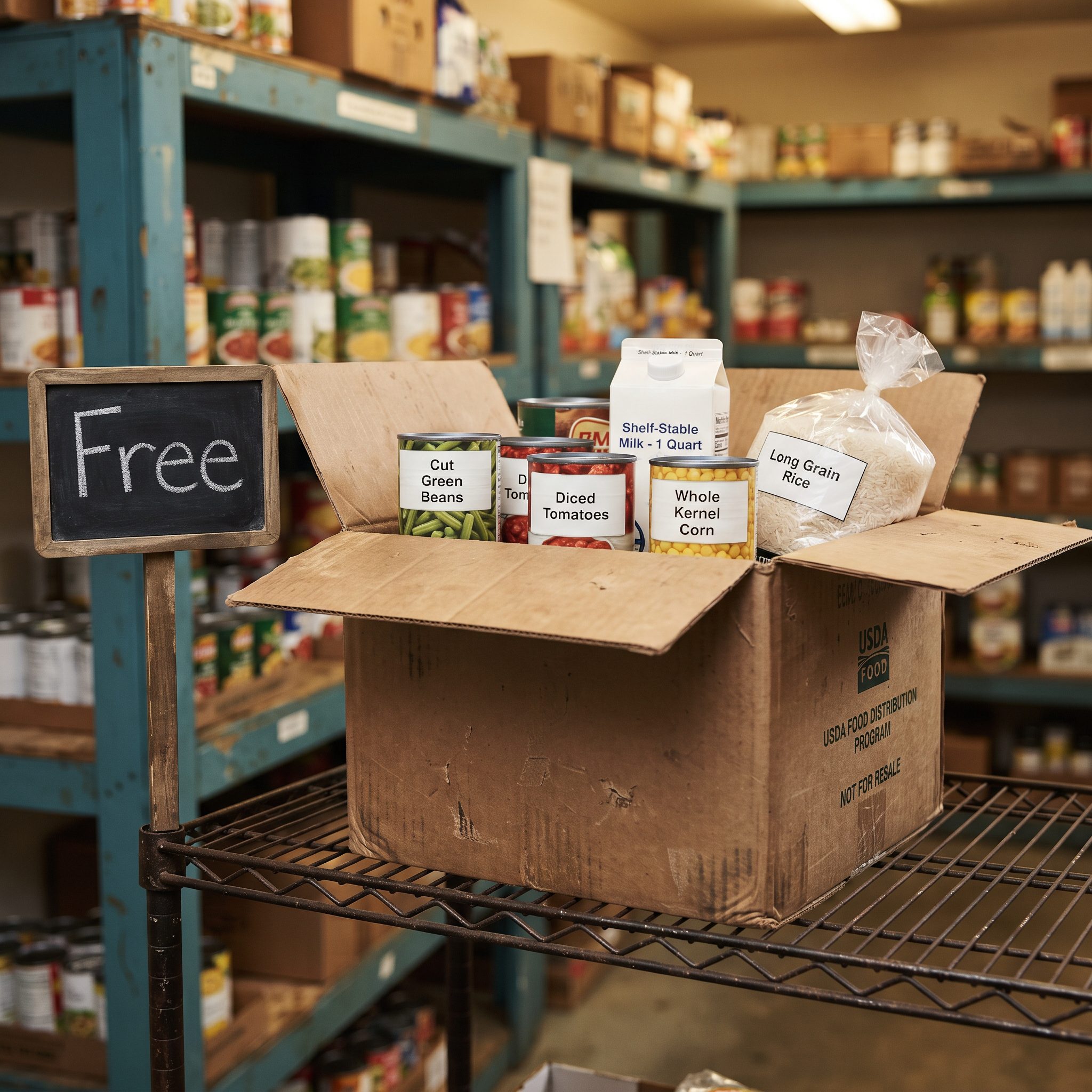
This is the part most families don’t expect. The same federal rule says plainly: “length of residency, address, or identification documents shall not be used as an eligibility criterion.” A state can require you to live within its borders, but it cannot demand ID, proof of address, or proof you’ve lived there for any set length of time to prove it.
How Self-Declaration Actually Works at the Table
In practice, this usually looks like a short form at the check-in table. Minnesota’s own 2026 TEFAP eligibility form asks a household to self-report its size and self-declare that its income falls at or below the listed figure.
The form states plainly that no Social Security number, proof of citizenship, or signature is required. A verbal self-declaration is accepted in place of a signature.
Connecticut runs the same way: no ID, no proof of residency or citizenship, no proof of income, and no birth certificates. A household simply states its size and confirms its income is within the limit.
The Fast Path If You’re Already on Another Program
Households already enrolled in SNAP, WIC, TANF, or Medicaid are generally treated as automatically income-eligible for TEFAP. There is no separate math to do. Bringing an Electronic Benefit Transfer (EBT) card or a benefits letter can speed up the conversation, though it is rarely required given the self-declaration rule above.
What Families Get Wrong
The most common mistake is assuming the family earns “too much” without ever checking the actual number. Marcus almost skipped the pantry for exactly this reason. A two-income household well above the minimum wage can still fall under a 300%-of-poverty ceiling, especially with kids in the household raising the limit.
The second mistake is confusing TEFAP’s pantry-box model with a soup kitchen or shelter meal, which has its own separate rule: anyone eating a meal at an emergency shelter or soup kitchen is automatically eligible, with nothing to prove at all.
Frequently Asked Questions
Do I need a government-issued ID to visit a food pantry? No. Federal rule 7 CFR 251.5 specifically bars states from requiring identification documents as a condition of TEFAP eligibility. Bring one if you have it, but a pantry cannot turn you away for not having one.
What counts as income when a pantry asks? States generally mean gross household income, before taxes, for every adult in the home. The exact definition is set by your state’s TEFAP plan, so ask the distribution site if your situation is unusual, such as irregular self-employment income.
Can I go to a food pantry even if I’ve never applied for any other benefit? Yes. TEFAP has its own, separate income test. You do not need to already be enrolled in SNAP, WIC, or any other program, though being enrolled in one of those can make the process faster.
Is there a limit on how often I can visit? Visit frequency limits are set by the state or the individual pantry, not by the federal income rule. Some states cap visits per month; others do not. Ask the specific site you plan to visit.
What if my state’s income limit is lower than 300%? Every state picks its own number inside the federal 185%-300% range, so yours may be lower than Minnesota’s example. Ask your state’s TEFAP office or local food bank for the current figure, since it changes when the federal poverty guideline updates each year.



Leave a Reply