

5 min read · Last updated July 10, 2026
In this article
- What the National School Lunch Program Actually Covers
- Who Qualifies – The Income Limit in Plain Dollars
- How to Apply – The Exact Steps
- What the Application Form Actually Asks For
- What Most Families Get Wrong
- What to Do If You Are Denied
- FAQ
Maria Torres has four children and earns $42,000 a year working as a home health aide in San Antonio. Every August, she fills out a single two-page form for her school district. Every year, all four of her kids eat a full school lunch for free, every school day from September to June.
The program is called the National School Lunch Program (NSLP). It is run by the U.S. Department of Agriculture (USDA) – that is the federal agriculture agency – and it provides free or reduced-price lunches at most public schools and many nonprofit private schools in the country.
What the National School Lunch Program Actually Covers
The NSLP provides one full hot or cold lunch each school day. The meal must meet federal nutrition standards: protein, whole grains, fresh fruit or vegetables, and low-fat milk. Schools cannot serve a smaller meal to students on the free program.
Most districts also operate the School Breakfast Program (SBP), which works the same way. One application covers both lunch and breakfast where the breakfast program exists. Ask your district whether your school participates.
The two programs are legally separate, which is exactly why so many eligible families never use the breakfast side. See why school breakfast participation lags so far behind lunch even in schools where both are free.
Free lunch means no charge. Reduced-price lunch means your child pays no more than 40 cents per lunch. Both are determined by the same form.
Who Qualifies – The Income Limit in Plain Dollars
The income limit is based on the federal poverty level (FPL), which is a number the government sets each year to define low income. You do not need to know what FPL stands for. What matters is the dollar amount.
For the 2025-26 school year:
| Household size | Free lunch (annual income) | Reduced-price lunch (annual income) |
|---|---|---|
| 1 | Up to $21,078 | $21,079 to $29,974 |
| 2 | Up to $28,548 | $28,549 to $40,612 |
| 3 | Up to $36,024 | $36,025 to $51,238 |
| 4 | Up to $43,500 | $43,501 to $61,862 |
| 5 | Up to $50,980 | $50,981 to $72,500 |
If your household income is at or below the free-lunch column, every child in your household qualifies for free meals. If you receive SNAP (Supplemental Nutrition Assistance Program – the food stamp program), Medicaid (free government health coverage for low-income families), or TANF (Temporary Assistance for Needy Families – a cash benefit program), your children qualify automatically with no income verification required.
How to Apply – The Exact Steps
Step 1: Get the form. Your school or district office has it. Most districts also post a fillable PDF on their website. Search for your school district’s name plus “free lunch application” to find the form.
Step 2: Fill out one form for your entire household. You list all children enrolled in the district and the names and income of every adult in the household. The form asks for gross income (before taxes) from wages, self-employment, and any government benefits like unemployment or Social Security.
Step 3: Submit before school starts if possible. Many districts process applications in the first two weeks of August. Getting it in early means approval is in place on day one.
Step 4: Wait for a letter. The district is required to notify you in writing. Approval typically comes within 3 to 5 business days. Keep that letter.
You do not send this form to USDA or any federal agency. It goes directly to your school district’s food service office.
What the Application Form Actually Asks For
The form has two sections. The first covers your children’s names and grade levels. The second covers household income.
For income, list every source: wages and salaries, alimony or child support, social security income, unemployment benefits, and any other regular income. Do not subtract taxes or deductions – list the gross (before-tax) amount.
One common mistake: listing only the primary earner’s income. Every adult in the home must be listed, including partners and other adults who contribute to household expenses.
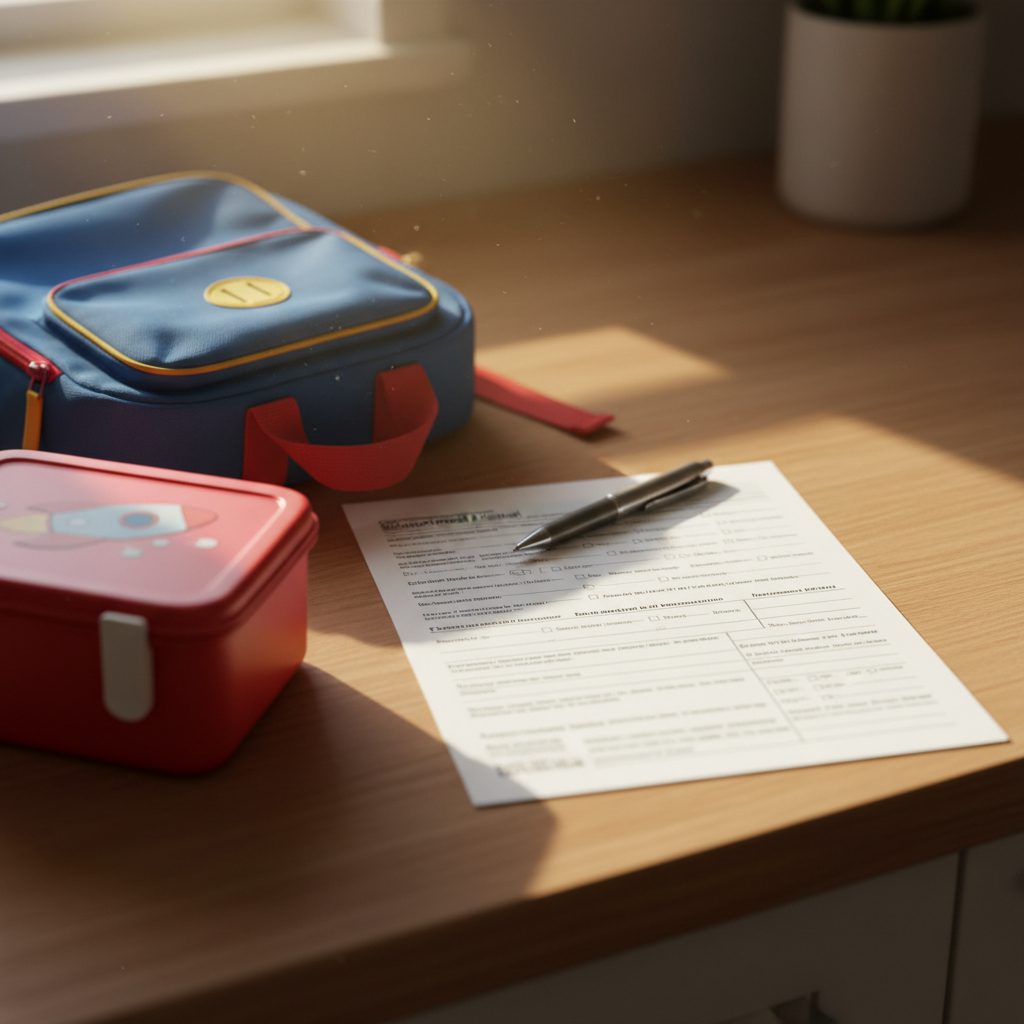
You do not need to submit pay stubs with the initial application. The district may verify income afterward, but the form alone is enough to start the process.
What Most Families Get Wrong
Waiting until September. Benefits do not backdate. If school starts September 8 and you submit the form October 1, your kids pay full price or skip lunch for September.
Using the wrong address. Families who moved over the summer sometimes submit the form to their old school. The form goes to the school district where the child is currently enrolled.
Forgetting to reapply every year. Approval expires at the end of the school year. You must submit a new form each fall. Districts typically mail a reminder, but the responsibility to reapply is on the family.
Leaving income blank. A form with blank income fields is automatically processed as a paid application. If you receive SNAP or Medicaid, write your case number in the designated box instead of listing income – that triggers automatic approval.
What to Do If You Are Denied
If your application is denied, the district must send you a denial notice in writing. That letter must explain why you were denied and describe your right to appeal.
You have 10 to 30 days (varies by district) to request a hearing. Put your appeal in writing, and bring documentation of your income. Approved changes are retroactive to the date of the original application.
If your income changed after you were denied – a job loss, a reduction in hours – you can reapply at any time during the school year.
Frequently Asked Questions
Can I apply after school has already started? Yes. There is no hard cutoff. You can submit an application any time during the school year. Benefits begin within a few days of approval. The only cost is the meals your child paid for between the start of school and the approval date – those are not refunded.
What if my income changes during the year? If your income drops during the school year, reapply immediately. The district processes mid-year applications the same way as fall applications. Changes take effect within 3 to 5 business days.
Does the free lunch program affect my family’s immigration status? The NSLP is not listed as a “public charge” program under federal immigration rules. Participation in free school lunch has not been used to deny immigration applications. For family-specific guidance, consult an immigration attorney.
My child goes to a private school. Do they qualify? Many nonprofit private schools participate in the NSLP. Contact your school’s administrative office and ask if they are a participating school. For-profit private schools are not eligible.
We already get SNAP. Do we still need to fill out the form? Yes, you still need to submit the form once per year – but instead of listing income, write your SNAP case number. This triggers categorical eligibility (automatic approval). The school is not allowed to ask for additional income documentation.
If your family just lost your housing and is staying with relatives or friends, this form is not the first thing that has to happen. Federal law already requires the school to enroll your child immediately, before any paperwork is sorted out. See the federal rule that guarantees immediate enrollment for families in that situation.





Leave a Reply