
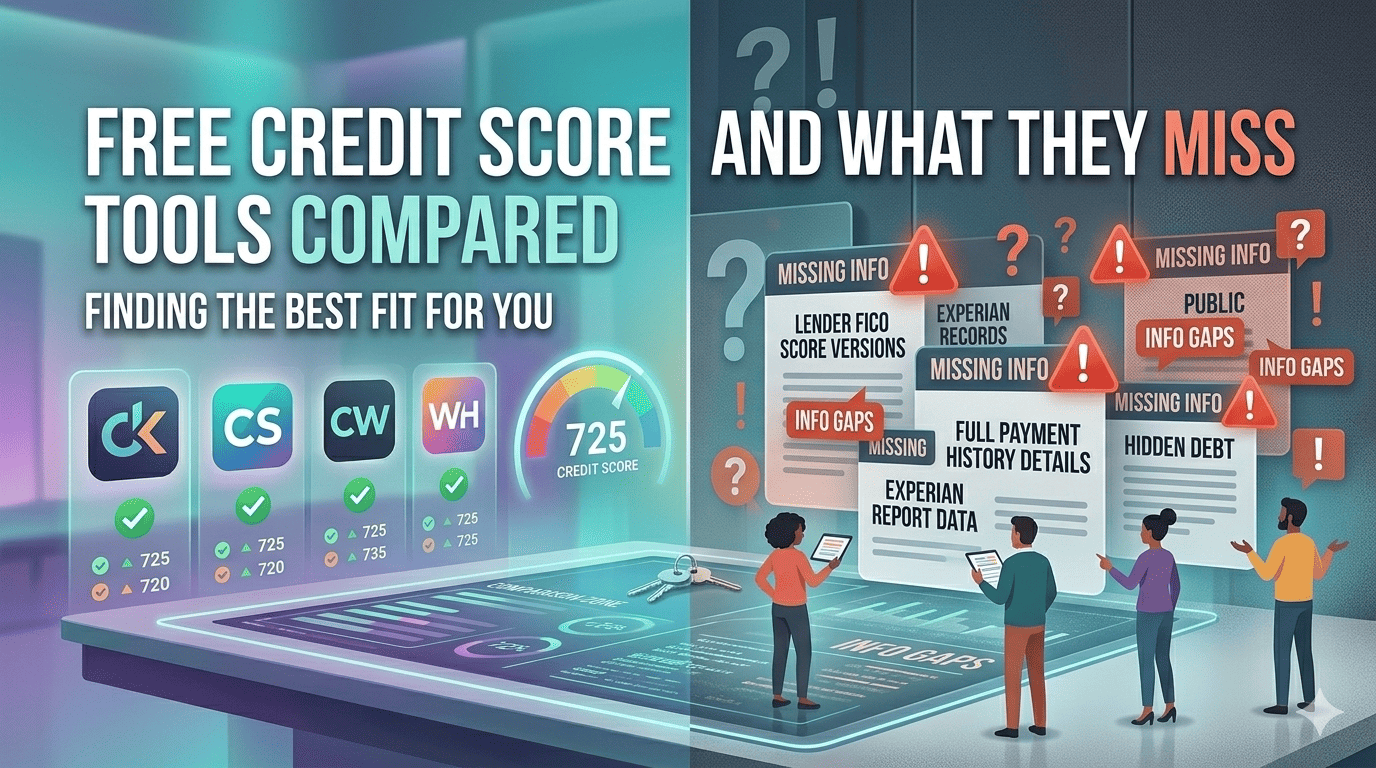
Checking your credit score used to require paying a fee or signing up for a trial that automatically charged your card after a short period. That changed dramatically over the past decade. Today, dozens of free tools let you view a credit score in seconds without any payment. Banks, credit card companies, personal finance apps, and dedicated monitoring platforms all offer free access to some version of your score at no ongoing cost.
The problem is that not all free credit scores show the same number, not all of them use the same scoring model, and none of them show everything a lender sees when they actually pull your credit for a lending decision. Treating a free score as a complete and accurate picture of your creditworthiness leads to surprises when you apply for a mortgage, auto loan, or apartment. This guide compares the most common free credit score tools and explains what they leave out of the picture.
Why Different Tools Show Different Scores
Your credit score varies depending on which scoring model is used, which credit bureau provides the underlying data, and when during the month the score is calculated.
FICO and VantageScore are the two main scoring models used in the United States today. FICO has multiple versions, including FICO 8, FICO 9, and industry-specific models designed for auto loans and mortgages. VantageScore has its own versions, with VantageScore 3.0 and 4.0 being the most common in free consumer tools. These models weigh your credit data differently, which is why two tools using different models produce different numbers from the same underlying report.
The credit bureau source matters as well. Equifax, Experian, and TransUnion do not always have identical information about your accounts. A creditor might report to all three bureaus, two of them, or just one. An error on one report might not appear on the others at all. Timing adds another variable, since credit data updates throughout the month as creditors report new balances, payments, and account statuses on their own individual schedules.
What Popular Free Tools Provide
Each free tool uses a specific scoring model and pulls from a specific bureau, which determines how close its number is to what a lender sees during an actual credit decision.
Most bank and credit card issuers that provide free scores use either FICO 8 or VantageScore 3.0 for their consumer-facing dashboards. FICO 8 is the most widely used general-purpose score, so a tool showing FICO 8 gives you a reasonable approximation of what many lenders see during initial credit evaluations. Our dedicated guide on credit monitoring services breaks down the differences between free scores and paid monitoring features in much greater detail for those who want a comprehensive comparison.
Dedicated credit monitoring platforms typically show your score from one bureau and offer paid upgrades to see all three simultaneously. AnnualCreditReport.com remains the only federally authorized source for free credit reports from all three bureaus. It shows your full report data but does not include a score number. You need the report and a score together to get the complete picture of your credit health.
What Free Tools Miss That Lenders See
Lenders often use industry-specific scoring models, pull reports from multiple bureaus at once, and review account details that no free consumer tool displays.
Mortgage lenders typically use FICO Score 2 from Experian, FICO Score 5 from Equifax, and FICO Score 4 from TransUnion for their underwriting decisions. These older models differ from the FICO 8 score that most free tools show consumers. A person with a free FICO 8 score of 720 might see a mortgage-specific score that is 15 to 40 points different. That gap matters when the score determines your interest rate tier or loan approval outcome.
Auto lenders use FICO Auto Scores, which weigh auto loan payment history more heavily than general models do. Free tools rarely show hard inquiries in full context either. A lender sees every inquiry along with the date, the type of credit requested, and whether multiple inquiries within a short window are being treated as a single event for rate-shopping purposes under the scoring rules.
How to Use Free Tools Effectively
Free credit score tools are most useful as trend trackers and early warning systems, not as exact predictors of what a lender will see during your application review.
Check your free score monthly to monitor the direction of your credit over time. A rising trend over several months confirms that your credit-building efforts are producing results. A sudden drop signals that something changed, and you should investigate by pulling your full report from all three bureaus to identify the cause of the decline.
Before applying for a major loan, ask the lender which scoring model and bureau they use for decisions. Some lenders share your actual score during prequalification, giving you a more accurate benchmark. Free credit score tools are a good starting point, but they are not the finish line for credit management.
Frequently Asked Questions
Why do different free credit score tools show different numbers? Your score depends on which scoring model is used, which credit bureau supplied the data, and when during the month the score was calculated. FICO and VantageScore are the two main models, each with multiple versions, and Equifax, Experian, and TransUnion do not always have identical information about your accounts. Because of this, two tools can pull the same underlying report and still produce different numbers.
Which free credit score is closest to what lenders actually see? Most banks and credit card issuers use FICO 8 or VantageScore 3.0 for their free consumer dashboards, and FICO 8 is the most widely used general-purpose score, so it gives a reasonable approximation for many initial credit evaluations. Mortgage lenders, however, typically use older models like FICO Score 2, 5, and 4 from Experian, Equifax, and TransUnion, which can differ from your free FICO 8 score by 15 to 40 points. That gap matters when it affects your interest rate tier or approval outcome.
Where can I get my full credit report for free, not just a score? AnnualCreditReport.com is the only federally authorized source for free credit reports from all three bureaus. It shows your full report data but does not include a score number, so you need the report and a score together to get a complete picture of your credit health. Checking your full report periodically helps you catch errors that a score alone would not reveal.
What do free credit score tools leave out that lenders see? Free tools generally do not show the industry-specific models lenders actually use, such as FICO Auto Scores for car loans or the older FICO versions mortgage lenders pull from each bureau. They also rarely show hard inquiries in full context, including whether multiple inquiries within a short window are being grouped together as a single rate-shopping event. This means your free score can look different from what a lender sees during an actual application.
How often should I check my free credit score? Check it monthly to track the direction of your credit over time rather than treating any single number as final. A steady upward trend confirms your credit-building efforts are working, while a sudden drop is a signal to pull your full report from all three bureaus and investigate the cause. Before applying for a major loan, ask the lender directly which scoring model and bureau they use so you have a more accurate benchmark.





Leave a Reply